
The Wisdom of the Owl
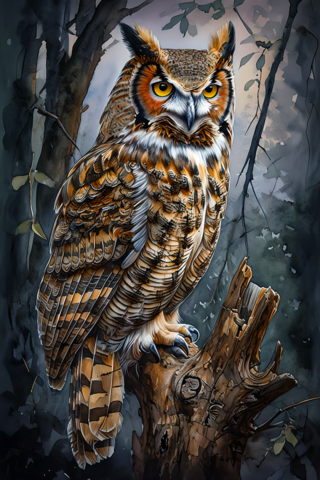
by Barb Casper
Tune in to the sacred wisdom within, and let it guide you toward health, wholeness, and inner harmony.
Dusk always did that thing it does at the edge of our yard—softening the city’s hard lines and turning the woods into one long shadow with a heartbeat. The streetlights hadn’t clicked on yet. A few cars slid past on the main road, their sound muted, as if the air itself were pulling a blanket up over the neighborhood.
My husband and I stood at the kitchen window the way people do when there isn’t much else to do—nothing dramatic, just two bodies leaning into the end of a day.
I hadn’t been feeling well for nearly a year. At first, it was easy to explain away: winter blues, a busy holiday season, maybe I was just getting older. But during the last month, it shifted, becoming progressively worse in a way that wasn’t loud, just persistent; a kind of decline that doesn’t announce itself with sirens, but with subtraction.
- Less energy.
- Less steadiness.
- Less joy in ordinary tasks.
Recently, walking felt as if my legs had been filled with lead. Every household duty became a negotiation: Can I do this now? Can I do it later? Can I do it at all? Sometimes, when I stood up from a chair, the room would tip, the air would thin, and I’d have to grip the counter like it was a promise. Dizzy. Light-headed. A little frightened—though not enough, somehow, to stop me from doing what I’ve always done: minimize, rationalize, push through, endure.
The previous spring, I went for a physical check up. I went again in the fall when things hadn’t improved. And because the scans didn’t show anything—because I was told my heart was strong—I wrote off the possibility that anything was wrong. I tucked that fear back into its drawer and shut it with a firm hand. I wanted to believe what I’d been told. I wanted my body to cooperate with the story.
At my kitchen window, I lifted a hand, sharp and instinctive, and said, “Oh my God—look at that.”
I wasn’t pointing at the sky the way people point at planes. I was pointing toward the woods.
At first, I saw only branches—dark on darker—until the shape resolved into something too solid to be a knot of bark. High in a tree at the edge of the woods, perched as if it had always belonged there, sat an owl.
A great horned owl!
Even before my mind supplied the name, my body knew the astonishment: those huge tufted “ears,” the broad chest, the heavy, composed stillness. Twilight was closing in, so I reached for binoculars to be sure. The owl was so still, so undeniably there, that the moment felt staged—like nature had arranged a scene just for us.
In more than thirty years of living in our home, we’d never spotted an owl. Not once. We live at the edge of town on a busy road. We get backyard birds, an occasional hawk, and, rarely, an eagle. But a great horned owl? Here?
It looked out of place and completely in place at the same time—like a secret stepping across a boundary.
The owl didn’t do anything dramatic. It didn’t swoop. It didn’t cry out. It simply sat there, a silhouette with intention, facing the open air as if the air had spoken first.
I realized I’d stopped breathing properly. My chest tightened with wonder. I whispered, as if the owl might hear me and take offense, “Look at the size of it.”
We watched. The owl watched back—or watched through us; I couldn’t tell. Its eyes were dark coins in the gathering gray, and in that stare, there was no sentimentality—only alertness. A calm that didn’t need to prove itself. A steady, unblinking knowing.
And something in me—something deeper than thought, deeper than my habit of toughing it out—felt answered.
Because this is what the months of not feeling well had been: an unclear signal. A vague feeling I’d glossed over. A steady uneasiness, I tried to smooth it into something acceptable. I told myself, “It’s fine. Maybe it’s my thyroid or one of my medications. I can handle it. Stop worrying—it’s probably nothing.”
But the owl, perched at the threshold of night, did not allow vagueness. It was made for what you can’t see well. Built for darkness, it didn’t apologize for taking up space. It didn’t pretend the woods were brighter than they were.
And the message that arrived—not in words, not in mysticism, but in the clean, instinctive language of attention—was simple:
Stop glossing over this.
Don’t panic.
Don’t catastrophize.
Don’t be afraid.
Pay attention. Get honest. Act.
Because that’s what the best “healthy vibe” ever is when it comes at exactly the right time: not a rush of false reassurance, but a sudden clarity that your body’s truth matters more than your ability to tough it out—especially when you’ve been trained to cope at all costs.
I felt it as an internal click—the sound of a latch releasing.
I had been trying to live as if everything were still daylight.
But something was happening in the dark that I couldn’t fully see yet.
I looked at my husband, and he looked at me, and the same thought lit both our faces—plain as a porch light turning on.
“We should take this seriously,” I said quietly.
And what I meant and what he heard—wasn’t about the owl. Not really. It was about me.
Inside the house, I moved differently that evening. Not faster. Not harder. Simply with a new respect for my limits. I sat down without arguing with myself. I drank water as if it were a small act of loyalty. I noticed how often I was compensating, how frequently I was bracing.
That night, I dreamt with a vividness that startled me awake. In the dream, someone I didn’t know—dressed in a white coat—spoke with crisp certainty: “An oxygen saturation of 50% isn’t a good thing, you know. You have a blocked artery. You need to get this taken care of.”
Suddenly, I was wide awake, heart thudding, on high alert.
The next day, the owl stayed with me—not as a magical creature hovering over my shoulder, but as a reminder of what I already surmised and had been ignoring: the previous tests hadn’t detected an issue, but I was living with the same symptoms and now they were worse. My body was not a courtroom where ‘no evidence’ meant ‘no crime.’
My body and what I was being told were the evidence.
I thought of my cardiologist’s recent certainty—adamant that my symptoms weren’t related to my heart. I didn’t resent him for it. I understood the comfort of certainty. But my lived experience had become too heavy to carry on someone else’s confidence.
So I did what I’m not always good at doing.
- I stopped minimizing.
- I stopped rationalizing.
- I stopped pushing through as if endurance were the same as health.
And then something clicked with a clarity I could no longer ignore: I needed help. And so, I asked for help again.
This time, when I described the fatigue that didn’t lift, my ‘lead’ legs, the dizziness when I stood up, the way every activity had become an effort I could barely manage, I didn’t soften it. I didn’t laugh it off. I didn’t add, “But I’m probably fine.”
I told the truth the way the owl had sat in that tree—steady, unblinking, taking up the space it deserved.
And that’s where the truth-finding happened—not as mystical knowledge, but as a process:
- Unease became evaluation.
- Vague symptoms became targeted questions.
- Fear became facts.
Whatever the eventual diagnosis and plan would be, the pivot was this: I moved from living in the blur to insisting on clarity. I insisted my body’s reality be taken seriously, even if earlier tests had looked normal. Even if I had been told my heart was strong and healthy. I refused to let “nothing showed up” erase the awareness that something was happening.
The owl didn’t give me a prophecy.
It gave me:
- Permission to treat uncertainty as information instead of an inconvenience.
- Permission to rest without guilt.
- Permission to ask again, even if I’ve already asked.
- Permission to say: ‘This matters.’
When I think back to that dusk, what stays with me most is the stillness: the way the owl held itself like a conclusion, the way the woods behind it looked endless and unknowable, and yet that darkness felt—strangely—navigable.
Not because the dark wasn’t real. But because clarity can exist alongside darkness.
I can still see that shape at the tree line—the huge tufted ‘ears’, the broad shoulders, the calm authority of a creature that doesn’t pretend night isn’t night. And I can still feel what rose in me in response: a sudden, grounded resolve.
- Pay attention.
- Get honest.
- Act.
And then, the most human part of all happened: I did. That owl and my dream saved my life!
Author’s Note
Your body and your mind don’t whisper symptoms for you to ignore—they are asking for care.
If something feels “off” and symptoms linger or worsen, don’t minimize or wait for perfect certainty. Speak plainly, seek evaluation, and keep advocating for yourself until you have clarity.
Don’t stop. Reach out, adjust course, and make changes when needed. Find someone who will truly listen—and who will go the extra mile to help you get answers. You deserve them.
Advocating for your health and taking action isn’t an overreaction. It’s a respect for your life.

